From Streets to Gravesites: How Has Protest in Iran Adapted after the Woman, Life, Freedom Movement
From Streets to Gravesites: How Has Protest in Iran Adapted after the Woman, Life, Freedom Movement
From Streets to Gravesites: How Has Protest in Iran Adapted after the Woman, Life, Freedom Movement?
Commentary by Sara Mohammadi Fatideh
Photocredit: Wikimedia Commons
The views expressed in this paper are solely those of the author and do not necessarily reflect the views of the oiip.
Information about the Author
Sara Mohammadi is a freelance journalist and activist. She holds a Master’s degree in International Development, for which she researched the transformation of protest repertoires during Iran’s Woman, Life, Freedom Movement of 2022. This policy analysis builds on that research, extending its framework to the protest cycles of 2025/26 and the new challenges introduced by the outbreak of the US-Israel war with Iran.
Executive Summary:
- After a nationwide protest wave in December 2025 and January 2026, driven by economic grievances and met with large-scale repression, public demonstrations largely subsided. However, dissent reemerged through adapted practices, including mourning rituals and student mobilization.
- Drawing on insights from the Woman, Life, Freedom movement in 2022, repression can be observed to reshape rather than eliminate protest. Mobilization becomes more fragmented, relational, and digitally coordinated, relying less on visibility and more on resilience.
- The outbreak of war with the United States and Israel has introduced compounding constraints: intensified repression, a closing media environment, and a rally-around-the-flag effect that has temporarily fractured opposition coalitions. These dynamics make visible dissent significantly more costly and complex than in previous cycles. Historical precedent, however, argues against assuming permanent demobilisation. The cemetery gatherings permitted after the 1988 mass executions gave rise to the “Mothers of Khavaran” and laid a groundwork for subsequent protest cycles.
Zusammenfassung:
- Eine landesweite Protestwelle im Dezember 2025 und Januar 2026 im Iran, die durch wirtschaftliche Krisen ausgelöst wurde, wurde mit massiver Brutalität niedergeschlagen. Daraufhin gingen Demonstrationen auf der Straße deutlich zurück. Dissens setzte sich jedoch in adaptierten Formen fort, unter anderem über Trauerrituale auf Friedhöfen und Studentenproteste.
- Aufbauend auf Erkenntnissen zur Frau, Leben, Freiheit-Bewegung von 2022 argumentiert dieser Beitrag, dass Repression Protest in autoritären Systemen nicht beendet, sondern transformiert. Die Mobilisierung stützt sich stärker auf zwischenmenschliche Beziehungen und wird digital koordiniert. Dabei gewinnt Resilienz an Bedeutung, während die öffentliche Sichtbarkeit in den Hintergrund tritt.
- Der Ausbruch des Krieges mit den Vereinigten Staaten und Israel hat die Bedingungen für Widerstand zusätzlich erschwert: zunehmende Repressionen, ein restriktiverer Zugang zu Internet und Medien und ein Rally-around-the-Flag-Effekt, der Oppositionsbündnisse vorübergehend gespalten hat. Diese Dynamiken machen sichtbaren Widerstand deutlich kostspieliger und komplexer als in früheren Protestzyklen. Historische Präzedenzfälle zeigen jedoch: Versammlungen an Friedhöfen, die nach den Massenhinrichtungen von 1988 geduldet wurden, gaben den Anstoß zur Entstehung von Gruppen wie der “Mütter von Khavaran” und legten einen Grundstein für spätere Protestzyklen.
Keywords: Iran protests, Woman Life Freedom, authoritarian repression, social movements, political dissent
In February 2026, mourners gathered at the gravesites of young protesters killed during earlier demonstrations in Iran, forty days prior. The so-called Chehloms stem from the Shia tradition of holding ceremonies on the fortieth day after death and often function as both acts of remembrance and forms of resistance as they allow communities to publicly mourn slain protesters while also expressing opposition to the state. Their cultural and religious significance offered a degree of protection, often enabling large turnouts despite the risk of repression (Khodaei 2023, 9). In one particular case, the mother of slain teenage protestor Mehrad Sadeghi held a speech at her son’s memorial in Isfahan, wearing his clothes and stating: “You may have killed the body, that once wore these clothes, but you cannot stop his path from continuing”. Pointing at the shoe and face mask, that he wore the night he was killed, she continues: “The last step he took in this shoe, I’ll take the next. The last breath he took in this mask, I’ll take the next one”. In numerous cities, these rituals were transformed into acts of resistance, featuring political speeches, chanting slogans against the regime, and even playing music and dancing (iranexplained 2026; weareiranianstudents 2026; iraniandiasporacollective 2026).
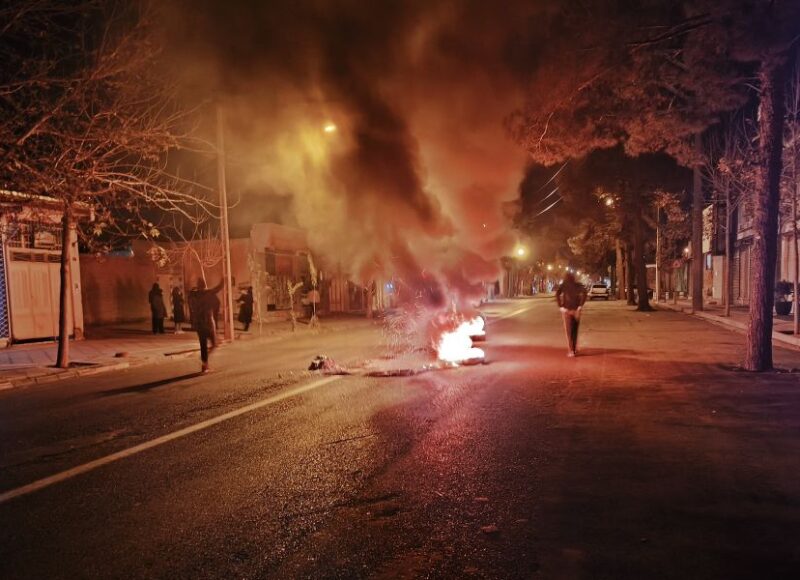
These Chehloms can be interpreted as a continuation of the street protests that erupted in late December 2025 and persisted into early January 2026. The initial wave of demonstrations was triggered by a deep economic crisis, rising prices, and the rapid devaluation of the national currency, which affected large segments of the population at an existential level. Thousands of merchants and bazaaris, historically supportive of the regime, joined students and workers in strikes and street demonstrations, and the movement rapidly spread across all 31 provinces, increasingly targeting the political system itself. Security forces of the Iranian state responded with lethal force and mass arrests. (Amnesty International, 2026; OHCHR 2026).
The exact number of protesters killed remains uncertain. Most fatalities occurred on January 8 and 9, 2026. According to the Human Rights Activists News Agency (HRANA), 6,507 deaths have been verified, with 11,630 cases still under review. Mehrad was one of at least 201 people killed by security forces in Isfahan Province. HRANA also reports 11,021 injuries and 51,465 arrests. Detainees included activists, journalists, students, medical personnel, and relatives of victims, many of whom were held without due process (Human Rights Activists News Agency, 2026).
Following this severe crackdown, street demonstrations largely vanished. Yet forty days later, families and friends of slain protesters again gathered at gravesites for Chehlom rituals, and school children filmed themselves singing protest songs in classrooms. By late February, days before the outbreak of war with the United States and Israel, students at multiple universities once again mobilized. During these gatherings, the slogan “Woman, Life, Freedom”, which had been largely absent in January, reemerged (sarahrmni a 2026; sarahrmni b 2026). The reappearance of earlier slogans and rituals suggests a degree of continuity across protest cycles that the severity of the crackdown had seemed, at least temporarily, to suppress."
Lessons from the Woman, Life, Freedom Movement
Research on the Woman, Life, Freedom Movement in Iran in 2022 provides a useful framework for understanding these dynamics. According to the United Nations Independent International Fact-Finding Mission on Iran (UN II FFM Iran), Jina (Mahsa) Amini was arrested on 13 September 2022 by Iran’s morality police (Gasht-e Ershad or Guidance Patrol) for allegedly wearing her hijab “improperly” . She collapsed after arriving at the Vozara detention center, was taken to a hospital, and declared brain-dead; her father reported signs of physical abuse. She died three days later from head injuries allegedly sustained during her arrest. Authorities blocked independent investigations and sought to obscure the circumstances of her death (UN II FFM Iran 2024, 3f.; Orazani & Teymoori 2024, 3f.). Despite state efforts to silence the families of victims of state violence, journalists Niloufar Hamedi and Elaheh Mohammadi documented Amini’s arrest and were subsequently detained (Kazemzadeh 2023, 157; Tohidi 2023, 30). The circulation of footage showing Amini’s lifeless body on social media sparked nationwide protests driven by anger at the morality police and skepticism toward official explanations (Human Rights Activists in Iran 2022, 5). Protests began at the hospital and in Amini’s hometown of Saqqez (Sadeghi-Boroujerdi 2023, 404f.). During her funeral, mourners – especially women – removed their hijabs, cut their hair, and chanted “Jin, Jiyan, Azadi” (“Woman, Life, Freedom”), a slogan rooted in the Kurdish women’s liberation movement and popularized in the writings of Abdullah Öcalan (Radpey 2023; Orazani & Teymoori 2024, 3f.). The Farsi translation “Zan, Zendegi, Azadi” quickly resonated across numerous Iranian cities and towns, and the protests evolved into a widespread movement. What began as outrage over the morality police’s violence soon expanded to encompass broader grievances against the Islamic Republic, including poverty, limitations on social and political freedoms, particularly for women, and systemic discrimination based on ethnicity and religion.
During the movement, public spaces became increasingly securitized by regime forces. Thus, activists turned to less visible and more fragmented forms of protest. Rooftops, private homes, and everyday urban spaces became sites of dissent. Cultural and social practices like the Chehlom rituals were repurposed as political arenas. This reflects what Tarrow and Tilly (2015, 14-17) conceptualize as the evolution of repertoires of contention, in which protest actors modify familiar tactics in response to changing constraints. According to Tarrow and Tilly (2015), contentious performances are established methods through which groups express collective demands, such as petitions, protests, or public meetings. These actions operate like performances drawn from familiar scripts that can be adapted across contexts. Their strength lies in being both modular (flexible and widely applicable) and context-sensitive (adaptable to local languages, customs, and symbols). The rise of the internet, they note, has further diversified these forms of contention by enabling decentralized, connective forms of action. Building on this, Johnston (2018) argues that not only protest movements, but also authoritarian governments develop such patterned strategies that evolve in response to each other: repertoires of resistance and repertoires of repression, respectively. In authoritarian settings like Iran, where traditional collective actions are restricted, activists turn to new and adaptive forms such as digital mobilization, everyday acts of defiance, or “social non-movements.” Over time, these evolving strategies constitute a dynamic system in which both state and society continually reshape the boundaries of political contention (Tarrow & Tilly 2015, 14–17; Johnston 2018, 20–28). In this context, various scholars like Bayat (2010) introduce approaches that aim to explain these alternative, everyday forms of resistance, which he refers to as “social non-movements:” shared, uncoordinated practices of ordinary people that, together, bring about social change without formal leadership or overt ideology (Bayat 2010, 4-19).
In the context of the Woman, Life, Freedom Movement, activists repurposed dispersed and often private settings as arenas of political expression. They reimagined various ordinary daily activities, like chanting off rooftops; appearing publicly unveiled and celebrating Nowruz in Kurdish and Baloch tradition as politically charged. Furthermore, through digital adaptations of these practices, the activists were able to keep these activities operational. They created encrypted messaging systems and used rotating Virtual Private Networks (VPNs) and peer-to-peer information-sharing systems to exchange tactical information with one another and carry out coordinated action. It was through these digital infrastructures that dispersed groups were able to maintain their independence while maintaining connection to larger networks opposing the state regime. Rather than serving as an alternative to street action, these tools contributed the infrastructure necessary to support continued activism in a period of extreme state repression. In addition to developing tactical and digital adaptations, protestors of the Woman, Life, Freedom Movement developed informal networks to provide care and solidarity to one another. With hospitals, universities, and other forms of public institutions increasingly turned into sites of state surveillance, activists built decentralized systems of support that provided medical assistance, legal guidance, emotional support, and safe practices within and beyond the context of the movement.
Furthermore, a defining feature of the Woman, Life Freedom Movement was the persistence of everyday acts of refusal. Individual behaviors, like appearing unveiled in public, reclaiming university spaces, or participating in cultural rituals, were ordinary in isolation, yet collectively they formed a diffuse but resilient pattern of civil disobedience. Over time, these repeated gestures subtly expanded the boundaries of what is socially and politically permissible, challenging state authority and entrenched patriarchal norms (Mohammadi Fatideh 2026, 81-83).
Mirrored Transformations: Implications for the 2025/26 protests
The developments observed in early 2026 closely mirror these patterns. The shift from mass demonstrations to Chehlom gatherings, classroom performances, and university protests indicates not a disruption in dissent but a transformation in its expression. The outbreak of full-scale war involving the United States and Israel introduces new constraints that may temporarily alter these dynamics. Contrary to claims by international political actors like Israels Prime Minister Benyamin Netanyahu, who frames such a moment as an opportunity for regime change (Pita 2026), when survival during a war becomes the immediate priority, visible forms of dissent are likely to recede as individuals face heightened risks and material insecurity.
At the same time, early developments suggest that dissent does not vanish entirely. Reports indicate that during the first night of the war, following circulating claims about the killing of Supreme Leader Ali Khamenei, some individuals briefly took to the streets in celebration (New York Times 2026). Simultaneously, war reinforces authoritarian control by legitimizing intensified repression and framing dissent as disloyalty. Human rights groups report that at least 1,500 people have been arrested since the outbreak of the war. (Iran Human Rights 2026). In parallel, reports point to a surge in executions of political prisoners (The Guardian 2026).
The media environment adds a further layer of complexity. The January 2026 protests unfolded under severe internet restrictions, yet images and footage circulated through Starlink terminals and encrypted messaging platforms, sustaining both international visibility and domestic solidarity networks. Wartime conditions risk narrowing these channels further. The continuous internet restrictions, the criminalisation of Starlink possession and the arrest of individuals for sharing content with foreign media signals a deliberate effort to seal the information environment at precisely the moment when documentation of state violence is most consequential. (Iran Human Rights 2026).
Yet the picture is further complicated by the rally-around-the-flag effect, a well-documented phenomenon where external military threat generates a surge in nationalist sentiment that cuts across existing political cleavages (Müller 1970). Iran is no exception to this dynamic. While the population is far from uniformly rallying behind the Islamic Republic, the US-Israeli strikes appear to have mobilised support for the defence of Iranian sovereignty, if not for the regime itself. As the Iranian-Swedish sociologist Mehrdad Darvishpour has observed, even activists and intellectuals with long records of opposition to the Islamic Republic, some of whom had accepted prison sentences for their dissent, temporarily reordered their priorities in the face of external threat, framing the defence of Iranian sovereignty as more pressing than regime change (Rezaee 2026).
Taken together, these developments seem to indicate a tension in the context of contentious political behaviour under conditions of war. While earlier patterns suggest that repression leads to the transformation of dissent into less visible and more dispersed forms, the extreme constraints of war may limit even these adaptive practices. The most direct historical parallel is Iran’s own experience during and after the Iran-Iraq War. The 1988 mass executions of political prisoners was carried out not in the heat of war but in its immediate aftermath and suggests that transitions in and out of armed conflict may represent particularly dangerous moments for opposition movements. As Abrahamian (1999, 218-220) argues, the slaughter of members of the Iranian oppositions, especially those with ties to the leftist Tudeh Party and Islamo-Marxist Mojaheddin-e Khalq served as a calculated instrument of internal consolidation: forcing unity among the regime’s various factions, severing connections between religious and secular radicals, and silencing dissent on questions of human rights and individual liberties. Thus, the lesson for the current moment is not simply that war further intensifies repression, but that the Islamic Republic has previously exploited moments of wartime to restructure the political landscape in ways that outlasted the conflict itself.
Once the 1988 executions had accomplished their purpose, the regime permitted mourning families to gather at cemeteries, and even turned a blind eye as they exchanged visits at cemeteries like Behesht-e Zahra and Khavaran (Abrahamian 1999, 217). From these gatherings emerged the grassroots activism of the “Justice-Seeking Mothers”, such as the “Mothers of Khavaran”: families of executed political prisoners who transformed collective mourning into sustained organised resistance. Inspired by Argentina’s “Mothers of Plaza de Mayo”, they gathered to demand justice for their disappeared children and later inspired similar groups like the “Mothers of Laleh Park” in 2009 and “Mothers of Aban” in 2019. These collectives formed non-hierarchical, counter-hegemonic networks that transcended class, ethnicity and religious divisions. Their actions laid important groundwork for the political consciousness and inclusive organizing seen in later protest cycles like the WLF Movement ( Assa 2023: 64; Mohammadi Fatideh 2026). Whether the gatherings of 2026 will emerge to comparable forms of organised dissent remains to be seen. What the historical record suggests, however, is that the transformation of private grief into collective political action has proven among the most resilient features of repertoires of resistance under the Islamic Republic of Iran.
References
Amnesty International. (2026, January). What happened at the protests in Iran?
https://www.amnesty.org/en/latest/campaigns/2026/01/what-happened-at-the-protests-in-iran/
Assa, S. (2023). Unveiling a Feminist Strike: The Case of „Woman, Life, Freedom” in Iran. Atlantis, 44(2), 53–71. https://doi.org/10.7202/1109372ar.
Rezaee, O. (2026, April 8). Teheran atmet wieder. Die Zeit. https://www.zeit.de/politik/ausland/2026-04/waffenstillstand-iran-usa-nahost-donald-trump.
Human Rights Activists in Iran. (2022). A comprehensive report of the first 82 days of nationwide protests in Iran (Sep–Dec 2022). Human Rights Activists News Agency (HRANA). https://en-hrana.org/wp-content/uploads/2022/12/82-Day-WLF-Protest-in-Iran-2022-English.pdf
Human Rights Activists News Agency (HRANA). (2026, March). At least 1,500 arrested in Iran as state intensifies domestic crackdown. https://iranhumanrights.org/2026/03/at-least-1500-arrested-in-iran-as-state-intensifies-domestic-crackdown/
iranexplained (2026). The mother of Mehrad Sadeghi, the teenager killed during the January protests in Isfahan [Instagram Reel]. Instagram. https://www.instagram.com/reel/DVEDuSmiMoC/.
iraniandiasporacollective (2026). Forty days after one of the worst massacres in modern memory [Instagram Reel]. Instagram. https://www.instagram.com/p/DU716gajMdI/
Johnston, H. (2018). Repertoires of resistance and repression: The authoritarian governance arena. Zeitschrift für Menschenrechte. https://www.zeitschriftfuermenschenrechte.de/blog/repertoires-of-resistance-and-repression-the-authoritarian-governance-arena/
Kazemzadeh, M. (2023). Mass protests in Iran: From resistance to overthrow. De Gruyter. https://doi.org/10.1515/9783111280288
Khodaei, M. (2023). Strategic analysis of the Woman, Life, Freedom uprising in Iran. Iran Academia Journal, 10, 1–18. https://doi.org/10.53895/iaj1010
Mohammadi Fatideh, S. (2026). Resistance and repression: Transformations of the Woman, Life, Freedom movement in Iran (Master’s thesis, Universität Wien).
Mueller, J.E. (1970). Presidential Popularity from Truman to Johnson. The American Political Science Review. 64(1). pp. 18–34.
New York Times. (2026, February 28). Iranians take to the streets to celebrate Khamenei’s death. https://www.nytimes.com/2026/02/28/world/middleeast/iran-khameni-celebrations.html
Orazani, N., & Teymoori, A. (2024). The manifold faces of political resistance: The WLF movement. https://doi.org/10.1093/9780197687703.003.0007
Pita, A.. (2026, March 10). Israel urges Iranians to rise up and overthrow the regime after Trump declares the war ‘very complete’. El Pais. https://english.elpais.com/international/2026-03-10/israel-urges-iranians-to-rise-up-and-overthrow-the-regime-after-trump-declares-the-war-very-complete.html
Sadeghi-Boroujerdi, E. (2023). Iran’s uprisings for ‘Women, Life, Freedom’: Over-determination, crisis and the lineages of revolt. Politics, 43. https://doi.org/10.1177/02633957231159351
sarahrmni (2026a). Students of Alzahlra University in Tehran. [Instagram Reel]. Instagram. https://www.instagram.com/reel/DVGG777jVk8/
sarahrmni (2026b). “Woman, Life, Freedom”. [Instagram Reel]. Instagram. https://www.instagram.com/p/DVGcgzqDYxA/
The Guardian. (2026, April 2). Iran: Iranian protesters, surge in executions amid war. https://www.theguardian.com/global-development/2026/apr/02/iran-iranian-protesters-surge-executions-death-penalty-war
Tohidi, N. (2023). Iran in a transformative process by Woman, Life, Freedom. Freedom of Thought Journal, 13, 29–57. https://doi.org/10.53895/ftj1314
United Nations Human Rights Council. (2024). Report of the independent international fact-finding mission on the Islamic Republic of Iran (A/HRC/55/67). Office of the United Nations High Commissioner for Human Rights. https://ohchr.org/sites/default/files/documents/hrbodies/hrcouncil/sessions-regular/session55/a-hrc-55-67-en.docx
weareiranianstudents (2026).Abdanan, Ilam Province – Feb. 17, 2026 [Instagram Reel]. Instagram. https://www.instagram.com/p/DU3YQ2aDJKQ/