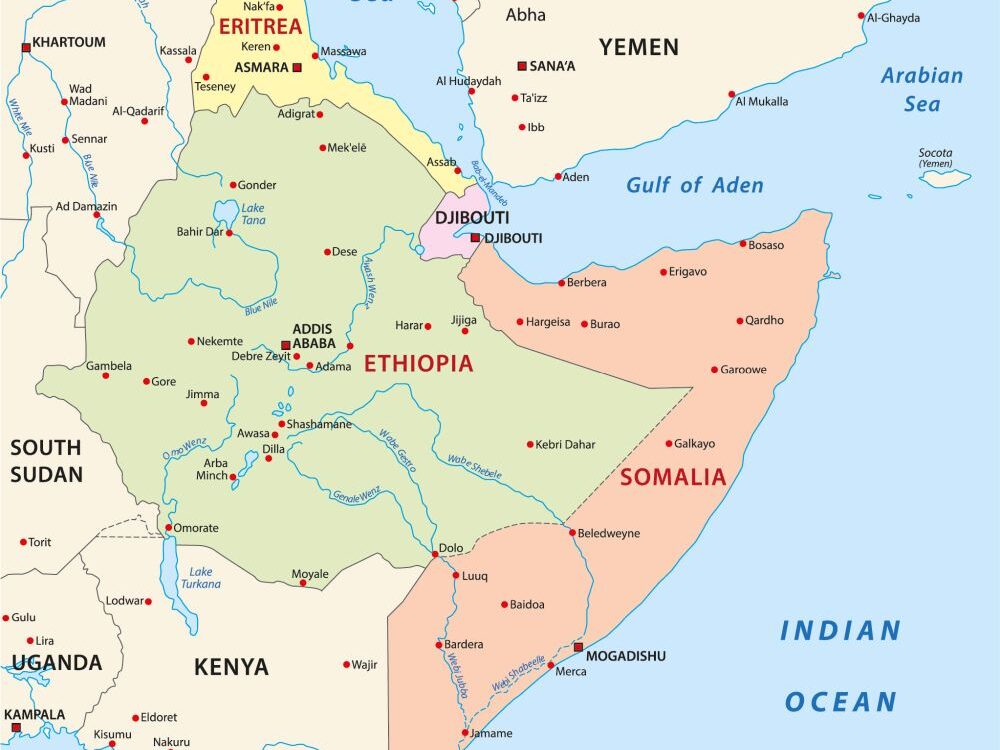
Module 8: The Wider Horn of Africa – Geopolitics, Political Risk and Business Environments
oiip Academy
Module 8: The Wider Horn of Africa – Geopolitics, Political Risk and Business Environments
11. June 2026

In this module of the “How to Navigate Geopolitical Risks” series, participants gain a structured understanding of the Wider Horn of Africa as a politically and economically interdependent macro-region connecting the Horn, the Upper Nile, the eastern Congo basin and the northern Swahili coast, shaped by shared conflict settings, security architectures, and infrastructure corridors. The course introduces key political, societal and economic dynamics and current risk profiles, embedded in a discussion of regional integration efforts. Participants are trained in identifying political risks and interpreting socio-economic signals in their daily work, and in integrating regional knowledge into strategic business decision-making. The day concludes with applied case exercises.
Fees per module:
€ 350.- Professionals
€ 150.- Students
Course Objectives
By the end of this course, participants will:
- Understand the historical, geographical and political scope of the Wider Horn of Africa
- Identify key conflict fault lines and regional stabilisation efforts
- Assess socio-economic trends and regional integration initiatives
- Evaluate political and regulatory risks for trade and investment
- Integrate political risk analysis into strategic business planning
Full-Day Schedule
09:00 – 09:30 | Welcome
Welcome & participant objectives
Course goals, structure, and approach (bottom-up political risk analysis beyond country profiles)
09:30 – 10:45 | Session 1: Understanding the Wider Horn of Africa
Objective: Develop a structural understanding of the region’s geography, history and political orders.
Topics:
- What defines the “Wider Horn”? IGAD and EAC as overlapping regional order
- Historical legacies: empire, colonial borders, liberation movements, secession (e.g. Eritrea, South Sudan)
- State formation, hybridity and informal governance
- Demography, urbanisation, mobility and cross-border economies
- Regional interdependence: ports, corridors, Nile basin, Red Sea access
Key Takeaways: A grounded understanding of political orders and social contracts across the region. Awareness of how historical trajectories shape current risk patterns.
Skills Taught: Contextual political analysis; comparative regime literacy; identifying structural versus cyclical instability.
10:45 – 11:00 | Coffee Break
11:00 – 12:30 | Session 2: Political Fault Lines, Conflicts and Containment
Objective: Map visible and invisible risks across the region.
Topics:
- Active conflict theatres and fragile transitions (Sudan, Somalia, eastern DRC, Ethiopia, South Sudan)
- Coups, militarization and constitutional instability
- Regional containment mechanisms: IGAD mediation, EAC interventions, AU frameworks
- External actors: Gulf states, Turkey, China, EU, US, Russia
- Climate stress, land pressures, resource competition
- Youth bulge, informal economies and social protest (example Kenya)
Key Takeaways: Understanding of the region’s layered risk profile and the interaction between domestic and regional dynamics. Recognition of early warning indicators beyond headline conflict.
Skills Taught: Conflict mapping; multi-level risk assessment; identification of slow-burn versus acute crises.
12:30 – 13:15 | Lunch
13:15 – 14:15 | Session 3: Socio-Economic Conditions and Regional Integration
Objective: Assess economic structures and reform trajectories shaping business environments.
Topics:
- Growth corridors and infrastructure
- East African Community common market, customs union, monetary integration debates
- African Union-related regional trade regimes
- Investment climates: regulatory reform, digitalisation, tax regimes
- Mining, energy, agriculture and extractive sectors
- Debt exposure and macroeconomic vulnerabilities
Key Takeaways: A differentiated view of business opportunity and risk structures across the region. Understanding how regional integration reshapes risk and market access.
Skills Taught: Reading macroeconomic and regulatory signals; linking political reform to business risk.
14:15 – 14:30 | Coffee Break
14:30 – 15:45 | Session 4: Setting Up Business – Risk, Regulation and Practice
Objective: Translate geopolitical literacy into concrete investment decision-making.
Topics:
- Import/export models and trade logistics
- Mining and extractive investment: licensing, political settlements and elite networks
- Informal institutions and patronage structures
- Sanctions regimes and compliance risks
- Security sector involvement in the economy
- Due diligence: identifying local partners and political exposure
Case Exercise:
- Scenario 1: A European trading company plans to establish an import/export hub in Mombasa serving South Sudan and eastern DRC.
- Scenario 2: An investment consortium considers entry into a gold or critical minerals project in Tanzania or DRC.
Participants identify key political, regulatory and security risks, early warning indicators, and mitigation strategies.
Key Takeaways: Understanding how political settlements, informal power structures and regional geopolitics directly affect commercial operations.
Skills Taught: Applied political risk assessment; translating qualitative analysis into executive recommendations; building organizational geopolitical awareness.
15:45 – 16:30 | Closing Session
Discussion and reflections
Curated source list (regional think tanks, multilateral institutions, local research hubs, risk monitoring tools)
Follow-up modules and networking
- Executive Handbook: Core Concepts in Geopolitics including relevant articles, policy analyses and maps.
- REFLECTIONS – oiip Magazine
- Curated Source List: Intelligence, think tanks, media, academia