Can Change Be Imposed from Outside? Revisiting a Letter from Iran, 1978 — and its Lessons Today
Can Change Be Imposed from Outside? Revisiting a Letter from Iran, 1978 — and its Lessons Today
Can Change Be Imposed from Outside? Revisiting a Letter from Iran, 1978 — and its Lessons Today
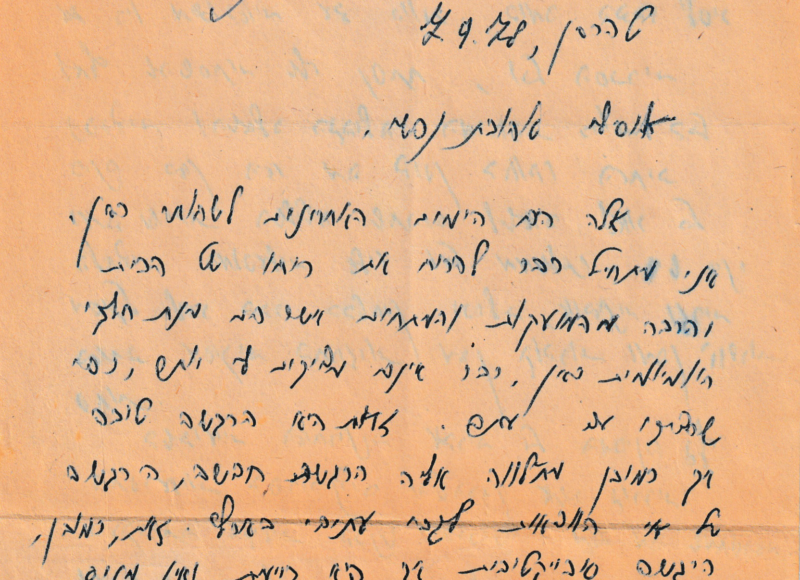
The following letter was written by Uri Lubrani, Israel’s last ambassador in Tehran, to his daughter Osnat in September 1978.
It has been translated from Hebrew into English and made available for publication by Osnat Lubrani for the oiip.
Uri Lubrani
served as Israel’s last Ambassador to Iran from 1973 to 1978
Osnat Lubrani
is a former Senior United Nations official and an Affiliate Researcher at oiip
Introduction
Last summer, in the context of the “12-day war” with Iran, I published in Haaretz a letter my father wrote to me from Tehran in September 1978. In my introduction, I highlighted his conviction that another political transformation would eventually come to Iran — but that such change could only come from within, and that it was neither Israel’s role nor within its power to impose or engineer it from the outside.
My father, Uri Lubrani, was serving at the time as Israel’s ambassador to Iran. In the final year of his posting, he remained alone in Tehran after our family returned to Israel, writing at a moment when the Shah’s regime was beginning to unravel — a development he was among the first to predict.
From what he was witnessing, he formed a view that stayed with him — and with me: that the Iranian people, who had once mobilized forces powerful enough to bring about a revolution comparable in spirit to the French Revolution, would one day be able to do so again, in pursuit of the freedom and dignity they seek and deserve.
Since then, I have found myself returning to that text — and to my own words — with a more difficult question: was he right?
Events have overtaken the question. A far wider war has since unfolded, with devastating consequences across the region. It has brought destruction to Iran, Israel, and beyond, affecting millions of civilians, while offering no clear political outcome.
In recent conversations with Iranians, I encountered a painful divide. Many continue to believe — as my father did — that change cannot be imposed from outside. But others — including people who have themselves been detained by the regime — no longer believe that internal protest can bring about change. For them, repeated cycles of protest followed by repression, arrests, and executions have demonstrated the limits of internal pressure.
There is also a generational divide. Some younger Iranians, particularly in the diaspora, are more inclined to view external intervention as a possible catalyst — a view shaped in part by distance from present-day realities inside Iran, and by inherited narratives about life before the 1979 revolution.
These perspectives do not align easily. They reflect the depth of the dilemma.
And yet, recent events have also tested the belief that external pressure can produce internal change.
There was a clear expectation — sometimes stated openly — that external pressure would trigger internal collapse: that people would take to the streets, that the regime would weaken under attack, and that war would accelerate change.
That expectation has not materialized.
When missiles are falling, societies do not mobilize for political transformation — they seek shelter. War does not create the conditions for civic action; it constrains them. It strengthens security structures, narrows public space, and shifts priorities from change to survival.
This dynamic is not unique to Iran. In Israel as well, war has reduced the space for dissent. Protest continues, but under increasing pressure and constraint. War, in this sense, does not empower societies — it disciplines them.
This may be the most important lesson of recent months: war tends to strengthen authoritarian structures and weaken the very forces needed for internal change.
The result is a striking gap between expectation and outcome. The war has inflicted damage, but not produced transformation. It has weakened societies more than it has weakened regimes. The Iranian regime, while under pressure, remains intact — and in some respects reinforced. The prospect of internal change has not been accelerated and may, in fact, have been pushed further away.
My father, writing in 1978 as he witnessed the collapse of one regime and the uncertain birth of another, understood something fundamental: that political change of this magnitude must be rooted in society itself — in its internal dynamics, its pressures, and its capacity to act.
Nearly five decades later, his words read not only as a reflection on that moment, but as a reminder of where the real drivers of change lie.
The letter that follows captures both the uncertainty of that time and the remarkable force of a society in motion — a force he likened to the energy of the French Revolution.
I return to it now with more questions than I had when I first published it — but also with a clearer sense of its relevance.
If change is to come in Iran, it will likely emerge from within — from those same societal forces that have surfaced before and may yet do so again.
What recent events suggest is that war does not bring that moment closer — and may, in fact, delay rather than advance it.
Osnat Lubrani
Tehran, 7 September 1978
Translation from Hebrew
My beloved Ossi,
These are among my final days here.
I am already beginning to smell the scent of home, and many of the strains and tensions that shaped my daily life here no longer weigh on me as they once did. It is a good feeling, but naturally it is accompanied by a new feeling as well—a sense of uncertainty about my future back home. This feeling is, of course, subjective, but very real nonetheless, and there is no escaping it.
I am leaving this country with a heavy heart. Precisely at this moment, Iran is undergoing a most fascinating process of revolutionary change throughout its political and social fabric. There is unrest, uncertainty, extreme internal tension, and no small measure of anxiety about what lies ahead.
Since my arrival, we have never witnessed such a heavy sense of uncertainty about what tomorrow may bring. The Shah is now fighting for the very survival of his rule and his dynasty, while those same shadowy forces that were suppressed until now by the regime’s heavy hand are rising up against him.
It resembles a pressure cooker whose valve has suddenly been opened—the dams are bursting, and the great question hovering everywhere is what the future holds, and how much control the Shah will retain in the face of all the pressures bearing down on him and his government.
No one can say anything with certainty. Everyone—Iranians and foreigners alike—is occupied with predictions, some darker than others.
Over the past two weeks, waves of unrest have swept through the provinces and Tehran, resulting in injuries and damage to property. Even what is published—now that far more is permitted to be published than in the past—is enough to cause considerable concern, and not everything is being published.
This is a revolutionary turning point in the entire framework within which we have operated here until now. My successor will undoubtedly encounter a new and far less sympathetic reality with which he will have to contend. By all accounts, this will be no easy task.
Yesterday we witnessed a mass demonstration—those in the know speak of hundreds of thousands; I did not count them. All were organized by opponents of the regime, primarily by the religious establishment. The demonstration passed very close to my residence, giving me the opportunity to witness it firsthand.
The entire Pahlavi Street was packed with people carrying placards and marching past in a procession several kilometers long. The chants and slogans alike were all directed against the Shah and his rule, demanding the return of exiled religious leaders to Iran and the granting of freedom of expression and organization. Nothing like this has been seen in Tehran for decades.
Along the sides of the road stood police officers and soldiers, not lifting a finger. On the contrary—the demonstrators showered them and the security forces with flowers, calling on them to join, for “they are one people, one country, with one will.”
It was an immense demonstration—disciplined and remarkably well organized—something that, in truth, the regime itself could not have planned or executed even if it had wanted to. This testifies to the organizational power of the opposition movement on the one hand, and on the other to the helplessness of the regime. It is quite frightening—because anyone who witnessed the spectacle could, with a bit of imagination, envision what might have happened had this mass demonstration turned unruly and violent. It could very quickly have escalated into a large-scale, unrestrained, pogrom.
The local press is now describing events in detail, without censorship restrictions, and criticism of the regime is receiving wide publication. Moreover, over the course of days more than thirty political parties have organized—parties whose existence was forbidden until a week or two ago—each competing with the others in the extremism of its platform and demands. It is truly hard to believe.
This is the Iran I am leaving, and no one knows how events will unfold. Will the Shah decide—or be able—to regain control of the situation, or will the unraveling of the governing fabric as we have known it continue, and to what extent? And we—Israel—where do we stand? This too is a weighty question, difficult to answer.
In this country we have many enemies. We are disliked not only because of the Middle East conflict and its repercussions, but also—as you know—because Shiite belief is intolerant toward Jews in general and Israelis in particular, as they are defined as enemies of Islam. Until now, the regime has served as a barrier against hostile actions toward us. What the future will bring—who can say.
Good tidings, salvation, or consolation? I don’t think so.
In my heart I know that this country will now go through—intermittently or continuously—a difficult and turbulent period, and to be honest, I am relieved that responsibility for our affairs will no longer rest on my shoulders.
I am very tired of this responsibility, and it is hard for me to imagine that I could summon the same mental—and even physical—strength required to deal effectively with the new reality. It is far better that someone new arrives here, with fresh energy, to carry this burden.
Yet beyond all these concerns, I must mention another aspect of the present reality that deeply fascinates me. The atmosphere here resembles what I imagine the eve of the French Revolution — or a similar social and political upheaval — must have felt like. It is a remarkable phenomenon, and an experience I will not soon forget: a people erupting in pursuit of greater freedom. To truly sense the force of the new winds blowing here, one must of course detach from the specific problems these changes pose for us—as Israelis and Jews—and think and feel as a citizen of the world, as someone accustomed to freedom of expression and organization, for whom any restriction in these realms runs counter to his worldview. It seems to me that momentous days have arrived for Iran, and there is no doubt that this country will emerge from this storm utterly different from the one we have known.
And now, having unloaded the weight of impressions that the current reality here has imposed upon me, I will say just a few practical words.
I do not yet know exactly when I will be able to leave here. (Yosef) Harmelin is advancing his arrival in order to be here as early as possible, and I will do my utmost to minimize the overlap period. I will make every effort to bring him up to speed and guide him during his initial stay here. This is my duty, and I will fulfill it, even though every fiber of my being is calling me home.
I assume that all of you in the family will read this letter; it is of course intended for all of you. I hope that the small, everyday troubles are not troubling you too much (…).
And as for you, Ossi—you can surely already begin counting the days until your discharge from the army, and perhaps that counting will bring you a sense of calm and good spirits. I will conclude, as usual, with a declaration of love to all of you together and to each of you individually. I will not even mention my longing.
Take care of yourselves and think of me from time to time. With great love, Dad
Uri Lubrani served as Israel’s ambassador to Iran from 1973 to 1978
Osnat Lubrani is a former senior United Nations official and an Affiliate Researcher at oiip
Downloads