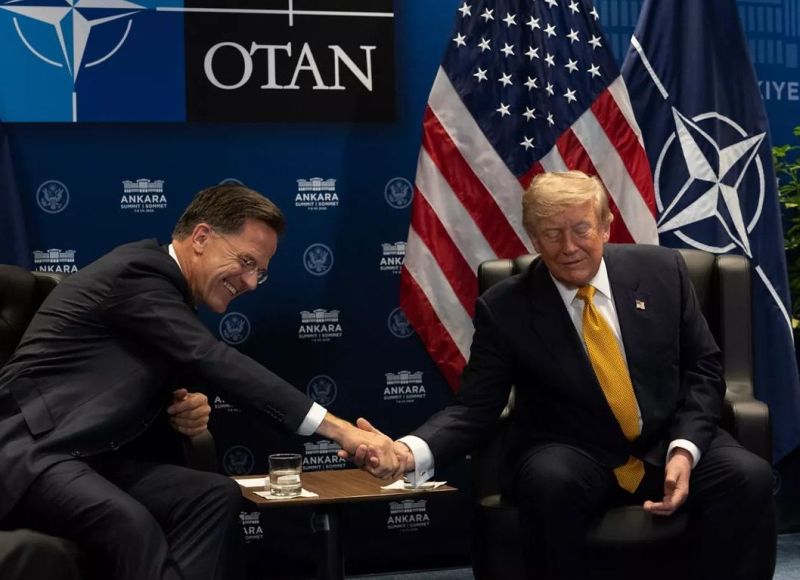
The 2026 NATO Summit in Ankara (7-8 July 2026): “Tremendous unity” won’t last forever
The 2026 NATO Summit in Ankara (7-8 July 2026): “Tremendous unity” won’t last forever


Situation Brief by Wyatt Cole, Loïc Simonet & Johannes Späth
July 2026
Authors:
Wyatt Cole
is an intern at the oiip. He is an undergraduate student at Skidmore College (NY, USA)
where he is pursuing a bachelor’s degree in International Affairs and History.
Dr. Loïc Simonet
started his career at the French Defence Ministry in Paris. In 2008, he was appointed Politico-Military Counsellor of the French Permanent Representation to the Organization for Security and Co-operation in Europe (OSCE) in Vienna. In 2013, he joined the Secretariat of the OSCE as Senior External Co-operation Officer, until June 2021. In this capacity, he liaised with the European Union and NATO. He joined the oiip in 2021 as a Research Fellow.
Johannes Späth, MA
is a Research Associate at the Austrian Institute for International Affairs (oiip). His work focuses on the intersection of geopolitics, the transatlantic relationship, and the security implications of emerging technologies.
At the institute, his research centers on U.S. foreign policy and the geopolitical influence of major tech actors. He further examines institutional shifts and governance trends, with a particular interest in the dynamics of autocratization and political economy in the Middle East and North Africa
Keywords: Ankara Summit, European Union, NATO, Ukraine, United States
DOI: https://doi.org/10.83003/sb_1_26
Abstract:
The 2026 NATO Summit in Ankara delivered its intended message: the Alliance is investing more, producing more, and standing behind Article 5 and Ukraine. Yet this display of "tremendous unity" rests on the untested premise of "NATO 3.0": a Pentagon-driven vision in which Europe assumes primary responsibility for its own conventional defense while the United States retains overall leadership. This paper argues that Ankara’s apparent success obscures rather than resolves the central tension of this transition. Behind several headline achievements lie six unaddressed structural problems: an undefined U.S. withdrawal timeline, growing exploitable divisions between "good" and "bad" allies, a European rearmament that risks deepening dependency on the U.S. rather than reducing it, an emerging friction between NATO 3.0 as a rebranded continuation of transatlantic dependency and the drive for genuine European strategic autonomy, an inconsistently applied "no more out-of-area operations" doctrine exposed by the Iran crisis, and Türkiye’s simultaneous indispensability and unpredictability. The paper contends that NATO’s structural logics have so far proven more durable than the volatility of any single administration. But this resilience should not be mistaken for resolution: as Europe assumes growing operational and financial responsibility for its own defense, its subordinate position in NATO’s command structure becomes increasingly difficult to sustain. Whether NATO 3.0 represents a durable reordering of the Alliance or merely a temporary accommodation of diverging transatlantic interests remains an open question — one Ankara deferred rather than answered.
Der NATO-Gipfel 2026 in Ankara konnte die gewünschte Botschaft vermitteln: Das Bündnis investiert mehr, produziert mehr und bekräftigt Artikel 5 sowie die Unterstützung der Ukraine. Doch diese Demonstration „enormer Einigkeit“ beruht auf der noch nicht erprobten Prämisse von „NATO 3.0“: einer vom Pentagon vorangetriebenen Vision, in der Europa die Hauptverantwortung für seine eigene konventionelle Verteidigung übernimmt, während die Vereinigten Staaten die Gesamtführung behalten. In diesem Beitrag wird argumentiert, dass der scheinbare Erfolg in Ankara die zentrale Spannung dieses Wandels eher verschleiert als löst. Hinter mehreren Schlagzeilen machenden Erfolgen verbergen sich sechs ungelöste strukturelle Probleme: ein unbestimmter Zeitplan für den Rückzug der USA, wachsende, ausnutzbare Spaltungen zwischen „guten“ und „schlechten“ Verbündeten, eine europäische Aufrüstung, die die Abhängigkeit von den USA eher zu vertiefen als zu verringern droht, eine sich abzeichnende Spannung zwischen der NATO 3.0 als neuaufgesetzte Fortsetzung der transatlantischen Abhängigkeit und dem Streben nach echter europäischer strategischer Autonomie, eine inkonsequent angewandte Doktrin der Vermeidung von “out of area” Einsätzen, die durch die Iran-Krise entlarvt wurde, sowie die gleichzeitige Unentbehrlichkeit und Unberechenbarkeit der Türkei. Die strukturelle Logik der NATO hat sich bislang als beständiger erwiesen, als die Volatilität einer einzelnen Regierung. Diese Widerstandsfähigkeit sollte jedoch nicht mit einer echten Lösung verwechselt werden: Da Europa zunehmend operative und finanzielle Verantwortung für seine eigene Verteidigung übernimmt, wird eine weiterhin untergeordnete Position in der Kommandostruktur der NATO schwerer aufrechtzuerhalten sein. Ob „NATO 3.0“ eine dauerhafte Neuordnung des Bündnisses darstellt oder lediglich einen vorübergehenden Kompromiss zwischen divergierenden transatlantischen Interessen – diese Frage bleibt offen, und Ankara hat sie eher aufgeschoben als beantwortet.
Photo Credit: NATO (permission to reproduce has been requested to NATO)
Downloads